B2B teams in the food, nutraceutical, and ingredient industries rely heavily on data every day, whether for sales outreach, supplier sourcing, compliance checks, or market research. Yet despite investing thousands in data tools, many teams still face the same outcomes: wrong contacts, outdated company data, missing certifications, and disconnected insights.
The issue is not access to data. It is the lack of structured, verified, and connected intelligence. This is where the shift from sales intelligence to a data intelligence platform becomes critical.
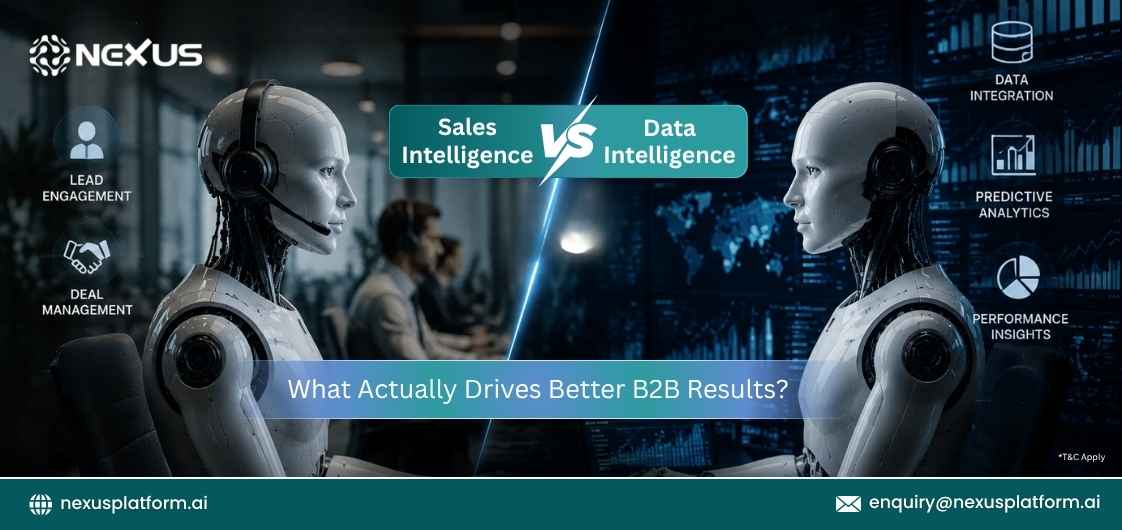
What Is Sales Intelligence?
Sales intelligence platforms are built to support outbound efforts by providing contact details of decision-makers, company-level information, and basic firmographic filters.
Where it helps: quick prospect list creation, initial outreach campaigns, and basic lead discovery.
Where it breaks down: in industries like nutraceuticals and functional ingredients, sales intelligence often struggles because contact data may be outdated or unverified, there is no visibility into products or ingredients, certifications and compliance data are missing, and information exists in silos. The result is teams spending hours validating, cross-checking, and correcting data before it becomes usable.
What Is a Data Intelligence Platform?
A data intelligence platform takes a fundamentally different approach. Instead of just providing contact data, it delivers structured, verified data organized into interconnected datasets that reflect real-world business relationships. This includes companies, decision-makers, products, ingredients, and certifications, including validity and expiry status.
What makes it different: structured data means consistent, filterable records instead of scattered fields. Verified records mean reduced errors and guesswork. Interconnected datasets provide full business context instead of isolated facts. Actionable insights mean the data is ready for a decision the moment you find it. The result is that teams move from searching for data to using data immediately, which is the core difference in data usability between the two approaches.
The Core Problem: Fragmented and Unreliable Data
Across the B2B food and nutraceutical ecosystem, most teams operate in a fragmented environment: multiple fragmented data tools for contacts, products, and certifications, spreadsheets for internal tracking, external sites for compliance verification, and manual workflows for validation.
This leads to weeks of manual research, high operational costs, and poor targeting that results in missed opportunities. Even after spending 5,000 to 30,000 dollars annually on data tools, teams often end up with invalid emails, wrong buyers, discontinued products, and missing or incorrect certifications
What Actually Drives Results
The difference comes down to data usability, accuracy, and depth.
From lead lists to qualified opportunities: sales intelligence generates large lists of contacts. A data intelligence platform delivers filtered, decision-ready prospects based on ingredients, product categories, certifications, geography, and company type, producing higher-quality leads with better conversion potential.
From manual workflows to automated intelligence: the traditional workflow means cleaning spreadsheets, fixing formatting issues, removing duplicates, and validating records manually. With data intelligence, data is auto-structured during import, errors are identified and corrected instantly, and records are validated before use, producing a significant reduction in setup time and manual effort.
From guesswork to verified decisions: in industries where compliance matters, missing or incorrect certification data can delay decisions. Data intelligence provides certification records and validity tracking, which supports compliance risk reduction and faster supplier validation.
From disconnected tools to a unified system: instead of juggling contact databases, certification lookup tools, product research platforms, and internal spreadsheets, data intelligence centralizes everything into a single system. Teams making this shift report roughly 60 percent faster workflows and around 40 percent lower operational costs.
How Nexus Applies Data Intelligence
Nexus is designed specifically for the B2B food, nutraceutical, dietary supplement, and functional ingredient industries. It brings together four critical datasets: companies, people, products, and ingredients, enriched with certification data, including validity, and structured relationships between all entities.
Seamless data import with auto-mapping means Nexus automatically understands file structures, formats, and column types, eliminating manual data preparation, speeding up onboarding, and reducing setup friction.
AI-powered data validation and correction identifies missing fields, duplicate records, incorrect formats, and data inconsistencies, improving data reliability, reducing manual verification, and ensuring cleaner outreach and research.
Deep, verified market intelligence gives access to 10M+ companies, 12M+ decision-makers, 2M+ products, 3M+ ingredients, and certification datasets, producing high-depth, high-trust intelligence, reduced guesswork, and better sourcing and targeting decisions.
AI-powered prospect extraction enables filtering by ingredient, certification, geography, and company type, and identification of verified buyers and suppliers, resulting in more qualified prospects with less manual research.
Centralized intelligence and collaboration through a unified dashboard supports shared prospect lists, cross-team workflows, and better alignment between sales, sourcing, and marketing, producing faster execution and shorter deal cycles.
When to Use Sales Intelligence vs Data Intelligence
Use sales intelligence if you only need contact lists, your outreach is volume-driven, and context is not critical to qualifying a prospect.
Use a data intelligence platform if you require verified, reliable data, your decisions depend on products, ingredients, and certifications, you want to reduce manual workflows and costs, or you need multi-functional intelligence shared across teams.

Also Read: How Sales Teams in Nutraceuticals Can Get 3x More Qualified Leads
Conclusion
In today's B2B landscape, especially in data-heavy industries like food and nutraceuticals, the challenge is no longer finding data. It is making that data usable, reliable, and actionable.
Sales intelligence supports outreach. A data intelligence platform powers end-to-end decision-making, from prospecting and sourcing to compliance and strategy, and that is what ultimately drives results.